 How-to
Do Mosquito Misting Systems Kill Bees? The Facts
Last Updated: October 30, 2026
Quick Summary
Mosquito misting systems can kill bees, depending on the active ingredient in the spray, how and when it is applied, and whether bees are exposed directly or later through residue. Most mosquito products are insecticides, and bees are insects, so the product label and use site determine the real risk.
- Direct spray is the biggest risk, because a bee caught in a fine mist can be harmed right away.
- Residue on treated plants and flowers can remain toxic for a period after application.
- Aim nozzles away from flowering plants and hive locations, and skip cycles during strong wind.
- Run cycles in early morning or evening, when bees are less active.
- Check the EPA registration number and active ingredient on the label before buying any concentrate.
Table of Contents
- Do Mosquito Misting Systems Kill Bees? What the Evidence Shows
- How Automatic Misting Systems Work: Nozzles, Schedules, and Drift
- Mosquito Spray Effects on Bees: Direct Exposure Versus Residue
- Active Ingredients Compared: Pyrethroids, Larvicides, and Pollinator Toxicity
- Mosquito Control Without Harming Bees: Nonchemical and Site-Specific Options
- Automatic Mosquito Misting System Precautions to Protect Pollinators
- Natural Mosquito Spray and Bees: What "Bee-Safe" Claims Really Mean
- Booking a Pollinator-Conscious Misting Assessment With Floridian Mosquito Control
- Frequently Asked Questions
Do Mosquito Misting Systems Kill Bees? What the Evidence Shows
Do mosquito misting systems kill bees? The honest answer is that they can, depending on what is in the spray, how it is applied, and when it lands.
The short version: most mosquito products are insecticides, and insecticides are designed to kill insects. Bees are insects. Learn nonchemical and site-specific mosquito control options that avoid harming pollinators.
Here is what matters most:
- Direct spray is the biggest risk. A bee caught in a fine mist during application can be harmed right away.
- Residue is the slower risk. Treated plants and flowers can hold active ingredients for a period after application.
Many homeowners assume that anything sold for mosquitoes is harmless to pollinators. That assumption does not hold up well. Read the active ingredient and the label before you decide.
How Automatic Misting Systems Work: Nozzles, Schedules, and Drift
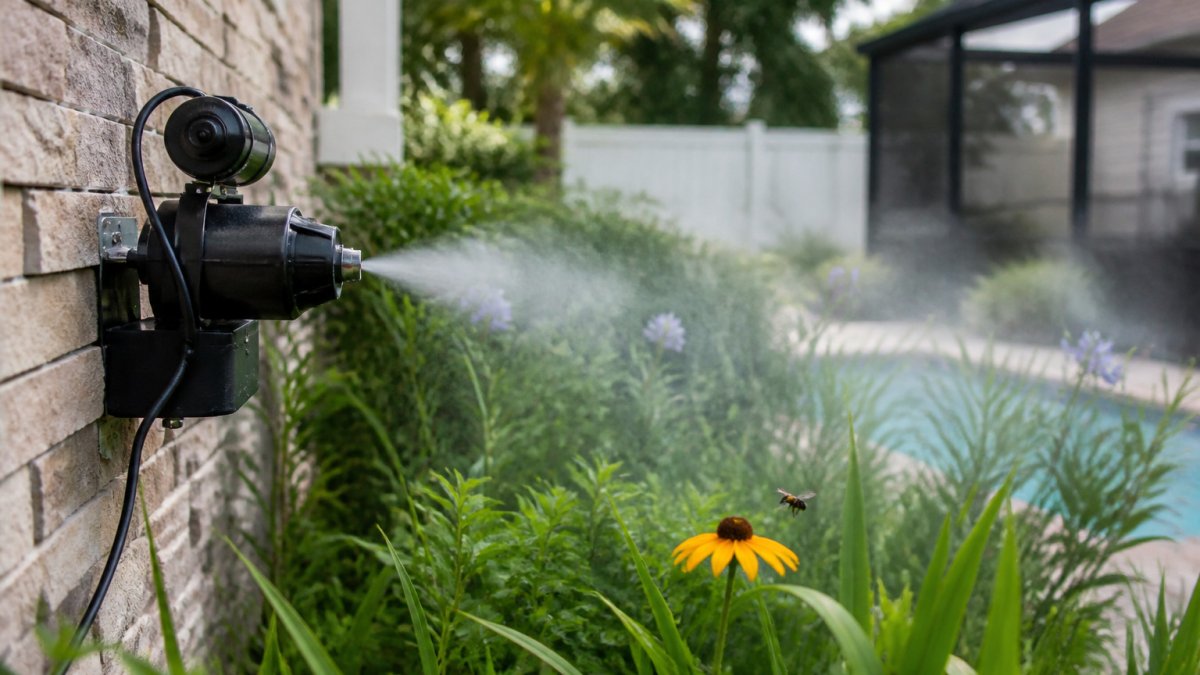
An automatic misting system is a network of tubing and small nozzles that releases a fine spray on a set timer.
Nozzle placement controls where the mist lands. Nozzles aimed at flowering shrubs or a pollinator bed put product right where bees feed.
Schedules control when the spray runs. Bees forage most during warm, sunny hours.
Drift is the spray that moves off target on wind. Even a well-placed nozzle can push product onto nearby hives or blooming plants on a breezy day.
A practical checklist for system setup:
- Aim nozzles away from flowering plants and hive locations
- Schedule cycles for early morning or evening, when bees are less active
- Skip cycles during strong wind
- Confirm the product label allows use near pollinators
Mosquito Spray Effects on Bees: Direct Exposure Versus Residue
Direct exposure and residue are different problems, and both deserve attention.
Direct exposure happens during the spray itself. A honeybee flying through a cloud of mist can take in the product on its body or in its gut. This is why timing matters so much.
Residue exposure happens after the spray dries. Learn why mosquitoes come back after professional fogging and how residue behaves. Foraging bees can contact treated leaves, petals, and bare ground. How long residue lasts depends on the active ingredient, the weather, and the surface.
Active Ingredients Compared: Pyrethroids, Larvicides, and Pollinator Toxicity
Bee risk is not a property of a product category. It is a property of the active ingredient, the formulation, the concentration, and the exposure route. Two products sold for the same mosquito problem can carry very different pollinator warnings.
| Active ingredient (class) | What it targets | Bee toxicity profile | Key label and exposure notes |
|---|---|---|---|
| Bifenthrin, permethrin, cyfluthrin, lambda-cyhalothrin (pyrethroids) | Adult mosquitoes | Highly toxic to honeybees on direct contact; residual toxicity varies by product and surface | EPA-registered labels carry bee cautions and often restrict application to blooming crops or during bloom; some labels prohibit use while bees are foraging |
| Malathion, naled (organophosphates) | Adult mosquitoes | Highly toxic to bees; some formulations carry explicit bee-hazard statements | Often restricted to public health or adulticide programs; residential misting labels are uncommon |
| Bacillus thuringiensis israelensis (Bti) | Mosquito larvae | Low risk to adult bees; targets larval gut receptors | Applied to standing water, not foliage; label directions focus on water bodies, not blooms |
| Bacillus sphaericus (Bs) | Mosquito larvae | Low risk to bees; bacterial larvicide | Same water-targeted use pattern as Bti |
| Methoprene (insect growth regulator) | Mosquito larvae | Low to moderate risk to bees; disrupts insect development | Water treatment; confirm label for use near apiaries |
| Spinosad | Adult mosquitoes and larvae | Highly toxic to bees, even at low residues; extended residual activity on treated foliage | Labels commonly warn against application to blooming plants and near hives |
| Essential oils (geraniol, lemongrass oil, peppermint oil, rosemary oil) | Adult mosquitoes (repellent or contact) | Variable; some plant oils are toxic to bees, and "natural" is not a safety claim | EPA-registered minimum-risk products still carry use directions; check for pollinator cautions |
Three label details decide most of the bee risk:
- The signal word and bee caution. Look for the EPA registration number and read the environmental hazards section. Pyrethroid labels frequently state that the product is highly toxic to bees and list application restrictions during bloom or when bees are actively foraging.
- The use site. A larvicide labeled for standing water is a different exposure scenario than an adulticide labeled for foliage and perimeter treatment. A product labeled only for outdoor perimeter use is not automatically cleared for flowering landscape plants.
- The formulation. Emulsifiable concentrates, wettable powders, and ready-to-use formulations leave different residues. Wettable powder and microencapsulated formulations can remain toxic on treated surfaces longer than some liquid concentrates, which matters for foraging bees returning to the same flowers.
EPA pesticide label and bee precaution information
Before buying any misting concentrate, compare the active ingredient on the label to the table above, then confirm the label permits use on the plants and surfaces your system will treat.
Mosquito Control Without Harming Bees: Nonchemical and Site-Specific Options
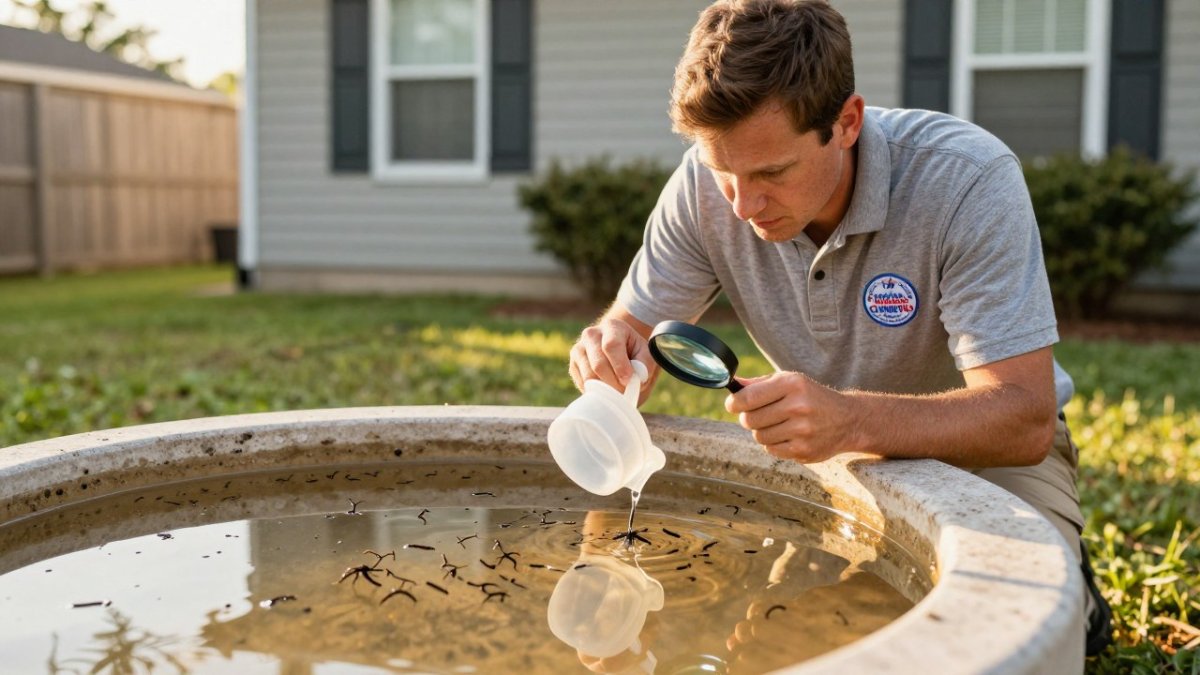
You can reduce mosquito numbers without relying on adult sprays. Start by removing the places mosquitoes breed.
- Empty standing water every week, including saucers, gutters, and buckets
- Cover rain barrels with fine mesh
- Add Bti larvicide to ponds and water features
- Trim tall grass and dense shrubs where adults rest during the day
- Run fans on patios during evening gatherings
Site-specific control means treating only the areas where mosquitoes actually live, not spraying the whole yard. A targeted approach often protects pollinators better than a broad treatment.
Automatic Mosquito Misting System Precautions to Protect Pollinators
The precautions below are organized as a practical checklist you can work through before the first cycle runs and again after each treatment, plus a response pathway if you suspect the system harmed a hive.
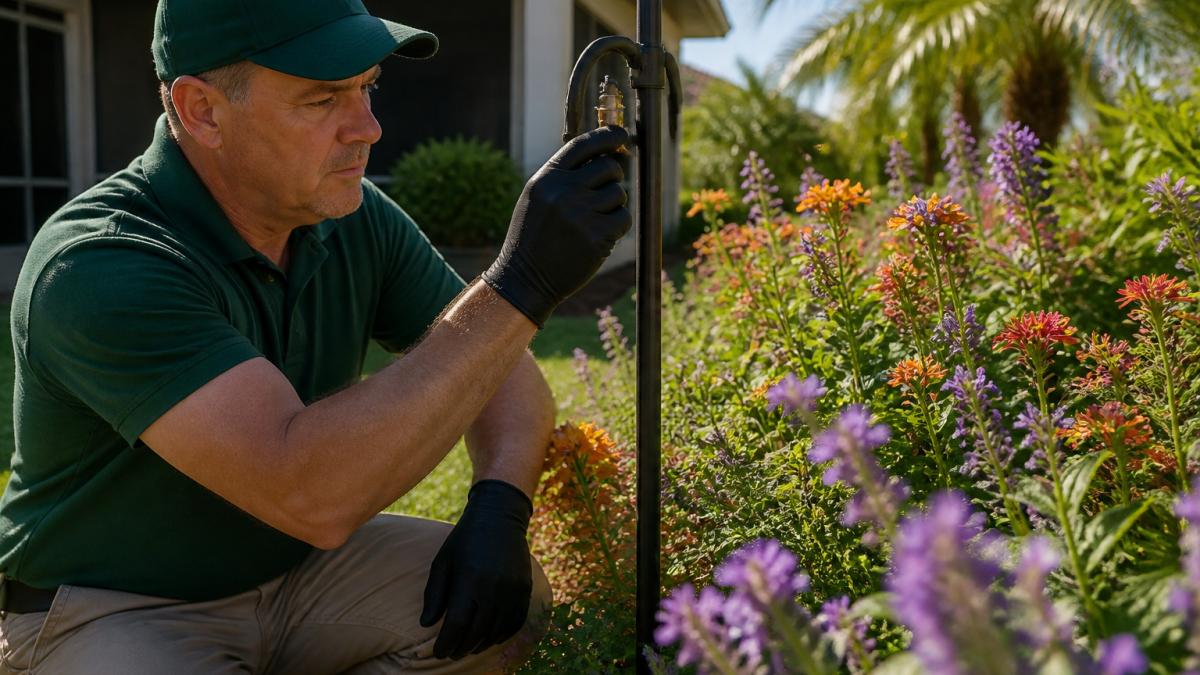
Before treatment: a hive and bloom checklist
- Locate every hive within at least 100 feet of any nozzle, including hives on neighboring properties. Ask neighbors directly; do not assume you would see them.
- Map flowering plants under and downwind of each nozzle. Note bloom periods for each species so you know when the highest-risk weeks fall.
- Confirm the label permits use near pollinators and on the surfaces your nozzles treat. A label cleared for perimeter use is not the same as a label cleared for flowering landscape beds.
- Set nozzles along fence lines, eaves, and shaded resting areas rather than into pollinator beds or vegetable gardens.
- Program cycles for early morning or after dusk, when honeybees are in the hive and most other pollinators are inactive.
- Add a wind cutoff. Skip cycles when wind would carry mist toward hives or blooming plants; drift is the most common way a well-placed system still reaches bees.
- Tell your beekeeper the treatment schedule so hive entrances can be closed during and shortly after a cycle.
- Keep a simple log of cycle times, products, and weather. This record matters if a problem appears later.
After treatment: what to watch for
Foraging bees that contact fresh residue may show disorientation, trembling, or inability to fly before dying near the hive entrance. A cluster of dead bees at the entrance within a day or two of a cycle is a signal worth investigating. So is a sudden drop in forager traffic during hours when the colony should be active.
If you suspect bee exposure or a bee kill
- Stop the system and do not run another cycle until the cause is identified.
- Document the incident: date and time of the last cycle, product name and EPA registration number, weather, photos of affected bees, and the location of the hive relative to nozzles.
- Contact the applicator or system provider and share the log. Ask for the label and safety data sheet for the product used.
- Reach your state apiary inspector or cooperative extension office for guidance; many states have a process for reporting pesticide-related bee kills, and your extension office can point you to the right agency.
- Report to the state pesticide regulatory agency if a registered product was applied contrary to its label. Label violations are enforceable, and the label is the legal standard for use.
- Preserve evidence, do not clean up dead bees or treated foliage before photos and notes are taken.
State apiary inspector and pesticide incident reporting contacts
If you keep hives or live near someone who does, treat the checklist as a living document. Revisit it when bloom periods change, when a neighbor adds a hive, and whenever the product in the tank changes.
Natural Mosquito Spray and Bees: What "Bee-Safe" Claims Really Mean
"Bee-safe" and "natural" are not regulated terms in the way many buyers assume. A product can be made from plant-derived ingredients and still be toxic to bees. Some plant-based oils and extracts harm insects broadly.
Ask three questions before you trust a claim:
- What is the active ingredient, and is it listed on the EPA-registered label?
- Does the label include directions for use near pollinators?
- Is there independent research on that ingredient's effect on bees?
If the label does not answer these questions, treat the claim with caution. Claims on the front of a bottle matter less than the label directions. Find practical guidance on choosing a natural repellent for a backyard patio.
Booking a Pollinator-Conscious Misting Assessment With Floridian Mosquito Control
If you have a pollinator garden, hives, or a busy outdoor space, a site assessment is the fastest way to find a safe plan. Floridian Mosquito Control, a locally owned family business and Certified Coastal Mister Dealer, provides professional installation, service, and repair of misting systems. Our licensed technicians can also install and service the system. Pricing depends on property size, system design, and service needs, so contact us for a quote. Call or text 813-433-3464 to schedule an assessment before your next treatment. Read a complete overview of mosquito control services before you book.
Frequently Asked Questions
Do mosquito misting systems kill bees?
Misting systems can harm bees if the product is applied directly onto foraging bees or onto flowers they visit during active hours. Pyrethroid insecticides are among the products of concern for bees. Residue on plants can also affect bees for a period after application. Reducing risk means choosing products labeled for mosquito use, following label directions, avoiding drift onto blooming plants, and scheduling sprays when bees are least active, typically at dusk or during cooler hours.
Is there a way to kill mosquitoes without killing bees?
Yes, but no approach is zero risk. Larvicides based on Bacillus thuringiensis israelensis target mosquito larvae in standing water. Eliminating breeding sites such as clogged gutters, empty containers and standing water removes the problem at its source. Site-specific treatments that keep spray away from flowers, combined with timing applications for low pollinator activity, lower exposure further. Always confirm the label before application.
Are natural mosquito sprays safe for bees?
Products marketed as natural or plant-based are not automatically safe for bees. Some botanical oils and essential oil formulations can still be toxic to pollinators, and the word natural is not a safety guarantee. Check the active ingredients and the pollinator precaution statement on the label, and ask your provider which products are used and how they will be applied around flowering plants and hives.
How can I protect pollinators around an automatic misting system?
Position nozzles away from flowering plants, hives and water sources, and aim spray low toward foliage where mosquitoes rest rather than into open blooms. Set timers for early morning or evening when bees are inactive, and avoid running the system on windy days to limit drift. Keep a record of the product and schedule so you can share it with your pest control provider and any beekeeper nearby.